INTERVIEW: AL SHIPLEY
THE AUTHOR OF A NEW BOOK ABOUT BALTIMORE CLUB

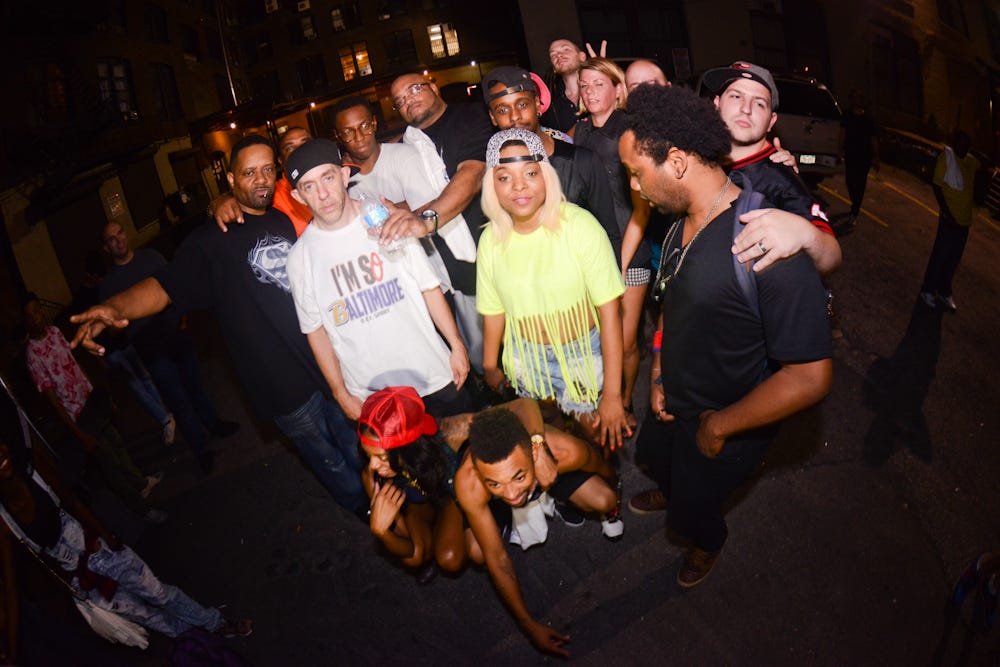
Tough Breaks, Al Shipley’s new book about Baltimore club music, has been in the works for over 15 years. In that time, the genre has continued to quietly assert its influence. If you see someone dancing to a fast K-pop song on TikTok, or rapping over a clubby drill track, or playing some sort of breakbeat-driven house tune on some sort of stream, there is a good chance that the spirit of Baltimore club is doing the SpongeBob in the corner.
Beginning around the turn of the ‘90s, Baltimore club fused several strands of high-energy dance music—British rave, Chicago house, Miami bass—into a breakbeat-driven stew. Many tracks consist of nothing more than a sample flip, a vocal loop, and a kinetic blur of drums. There has always been a bit of provincial mystery to this music, not unlike a Nuggets-era garage rock record or a regional soul song. Though it is connected to an international array of styles, many of the most exciting Baltimore tracks have an urgent, hyper-local feel. And for a long period, the music did stay within the confines of the DMV, bolstered by a network of clubs, record stores, and radio shows.
Around 20 years ago, Baltimore club started breaking out of its silo, in part thanks to a network of blogs and message boards. I’ve been lucky enough to play shows with a lot of my favorite DJs and producers in the genre; I have pretty powerful memories of seeing legends like the late K-Swift and DJ Technics spin in the city where the music was born. Reading Tough Breaks was a reminder of how important this stuff is to me. It’s a comprehensive look at the style and the local infrastructure that allowed it to flourish. I’m glad it exists, and I’m happy I was able to chat with Al about all things Baltimore club.
There’s an absurd amount of books about rock and rap music. There’s maybe less out there about dance stuff. This is the first book on Baltimore club.
It’s very exciting to be able to do the first book on a subject. I have read a good number of the books that are out there about dance music—a lot of times they’re very broadly about decades of different scenes, because dance music is like heavy metal where it’s been atomized into 100 subgenres. This worked out well, where I could zero in on just this one setting and this one scene because it was such a hyper-local thing for such a long time.
There was a good ten years where it was very popular in Baltimore and people really didn’t know about it anywhere else. It was a little cut off from the rest of the dance music world. It eventually established a relationship with the larger world, but I got to focus on the way that it was really in its own little petri dish here in Baltimore.
The Baltimore club story feels like the story of a lot of near misses. Do you think there’s an alternate reality where club music really breaks in a more pronounced way nationally?
There’s some other possibility where things could’ve taken a different turn. When Frank Ski had “Doo Doo Brown,” that was on the Hot 100. It was kind of mixed in with the Miami bass stuff that went really huge. There were Miami records, all these dance records that were kind of an outgrowth of hip hop, so, yeah, you could have seen some of that music go mainstream in the ‘90s. There’s other parts of the book where I talk about how Pharrell from the Neptunes, he’s from Virginia, he heard Baltimore club music just from the regional spread of music, and he loved it, and he tried to sign Rod Lee.
Rod Lee, who was very successful in Baltimore, he was happy being his own boss. So he just kind of blew off Pharrell. Who knows what would have happened if he signed with Pharrell—could have been nothing, could have been something huge. There are other records that blew up in niche ways that could have been more mainstream. But also, the things that did happen the way they happened allowed the music to keep developing, especially in a very sample-based way, when in mainstream hip hop, suddenly, you couldn’t sample really freely. I don’t know if Baltimore club would have developed creatively the same way it did if they got the same lawsuits that Biz Markie got in the early ‘90s.
Those records sold well within the region, but they weren’t traveling. Whoever might try to sue them, there wouldn’t be enough financial stakes to even spend money on lawyers.
Rod Lee was like, Yeah, they would hit me with these little things and I would just do nothing because I knew that they weren’t really going to go after me unless I sold X many records and he never got to that level. He was making great money because he was a label owner, DJ, producer. With a lot of these guys, they had more local glory than financial benefits, although some of them, again, I think made a pretty good living at their peak.
If you’re a regional artist or someone who’s not known outside of your home state, it’s still not usual for you to be able to turn on the radio and hear your song, go into a club and see a thousand people dancing to your song. These guys got to enjoy that kind of enthusiasm for their music and really see it and interact with their audience. They would take an unreleased track into the club, test it, see how people love it, maybe keep tweaking and then release it. It was really cool the way they got to foster this community around the music. Dance music, it’s not always hyper local.
It must have been surreal for some of these people when, come the mid-2000s, there’s this whole different interest in the music, especially from England and Europe. By that point, it seems like some of these DJs were already a little bit burnt out on the sound.
It’s interesting, because by the time I started interviewing people around 2006—the late, great Dukeyman was like, to me, it’s dead, an “I’m over it” kind of thing, because he did hip hop and he was also involved in a lot of different things musically. By that point, also, some people were starting to move away, the scene was starting to fray a little bit, then you had this other generation coming in. I was doing a book event the other night and Shawn Ceaser from Unruly Records was talking about how in the mid-2000s when DJ K-Swift was at her peak, and they were releasing her mix CDs, they could outsell a Jay-Z album in Baltimore stores. Everyone wanted a mix CD of their favorite songs, that was more consumer friendly for people who weren’t DJs.
It seemed like a lot of younger people were into it after a point.
They would have these more all-ages things at skating rinks and matinee events at a nightclub. It became more of a routine thing at some point. It wasn’t just in these really, really late-night afterhours spots. And also, the music was getting a little faster and more physical and people were doing dance squads, where you know, they would create dances for particular songs. Some of it was spontaneous.
Definitely it evolved and it became more youthful. A lot of people who were originally dancing to stuff in the ‘90s, they could be in their 50s and 60s now, a lot of the DJs are. But there was this whole wave of people that are even younger than me, because they all were born in the ‘80s, then there were people that were born in the ‘90s who grew up going to these matinee kind of dance events.
I remember being on tour in 2005, the first time I was in Baltimore, and we went to Club Choices after our show at Tarantula Hill. We showed up and they were playing rap music all night, and we had to ask them to play Baltimore club. And I think they were even a little confused as to why these weird kids from out of town were so excited about that music.
The funny thing is that there’s this almost antagonistic relationship between Baltimore hip hop and Baltimore club. But a lot of the biggest hip hop songs that have come out of here have been produced by club music guys and some of them have a club music tempo. But there’s always this push and pull of like, you know, Oh, would we have a better hip hop scene if club music hadn’t sucked all the air out of the room and taken up a lot of the energy in terms of what people were wanting to listen to in the city.
Shawn Ceaser said like, in the ‘90s we would listen to club music for seven hours in a row, snd then maybe towards the end of the night, they would play a half hour of hip hop. Whereas by the mid-2000s, that had inverted a bit. Yeah, people want to go and hear 50 Cent, they want to hear Jay-Z. Then you’ll get the set of club music at some point or late at night.
What’s a record that you think epitomizes the genre?
I feel like a lot of the Booman and KW Griff stuff on Unruly, like “Pick Em Up,” “Watch Out For The Big Girl.” Those are really genre defining. 2 Hyped Brothers & A Dog “Doo Doo Brown” was a big moment and it was very early in the genre, but it’s almost an outlier because people were still figuring out what the sound was going to be like and it was such an accidental evolution. You can’t tell the story without that song, but that’s not a song people would play in a club set compared to a lot of those other songs. Rod Lee “Dance My Pain Away,” you know, it’s hard to argue with that as being anything but the definitive song. Again, it’s kind of an outlier because it’s a little more melodic. It’s got this kind of emotional component that almost nothing else in the genre has, but it’s just a perfect song.
DJ Class “Tear Da Club Up,” another huge one. And the things that really changed the music, Debonair Samir “Samir’s Theme,” that really changed how everyone used synths. There’s just a handful of records that have a really special place in the genre, but then there’s all these other party classics like, you know, Big Ria “Hey You Knuckleheads,” people just go apeshit for that record and that’s less than two minutes long and it’s just shout outs for two minutes. It’s just this perfect local performance. The Miss Tony records. A lot of these are based on samples, but a lot of them are just these like really memorable vocal performances.
A lot of these tracks feel like they were assembled very quickly.
These guys were incredibly shrewd, they knew their audience. There was probably some trial and error, but I would ask them, like, did you have a song you loved and you tried in the club and it didn’t work? And they’re like, Probably, but I don’t really remember them. These guys actually probably have amazing unreleased records that they just played in a club when the club was kind of dead one night and thought, Oh, that didn’t work. So I’ve really encouraged them, you know, to make sure you go through the archives because there might be amazing stuff that just hasn’t seen the light of day. Again, this was all very based on having the next song that’s going to be taken to the club this weekend that you can put in on an EP in the store the next weekend.
They mastered the form, and you can hear them being creative within these tight parameters in a way that’s so satisfying.
I remember being younger and hearing stuff on the radio before I even recognized that it was actually local music. I just thought, Oh, some of these radio stations play this weird, fast house music. Because, you know, radio stations, especially in this area, they’ll play go-go, and they do a dancehall set. There were all these different styles that got into the mix when the DJs played at night. When I realized, Oh, this is all local stuff—there’s Chicago records that kind of have been grandfathered into the Baltimore Club, like “Percolator” and whatnot—but for the most part, it’s all stuff that was made here. Just to realize that at some point was mind blowing.
This is like a funny question, but roughly how many Baltimore Club 12 inches do you think were made between the early ‘90s to the mid-2000s? I’m just trying to wrap my brain around this body of music. It seems like it’s finite.
When I started this project, I thought about trying to do something like that and really catalog everything. It’s got to be in the hundreds, could be in the thousands. And the interesting thing is that from the mid-90s to the mid-2000s, when the main format was these vinyl singles, there were so many DJs and producers that were putting out records, sometimes once a quarter, sometimes once a month. After that point, when mixed CDs got big and MP3s got big, I think it exploded in a different direction. There are a lot of tracks from the 2000s onward where they might never have been on vinyl, but were still really popular on mix CDs or circulated on MP3. It’s thousands of songs, at least a thousand that were on vinyl. I would love to eventually have an answer for you there.
It’s kind of exciting thinking about it. You might be able to, if you really worked at it, own a good chunk of this music made in the ‘90s.
Yeah, there’s a part of me that wishes I had just gone into this as a vinyl collector. If I had more space in the house, maybe I could have tried it, but I have my couple crates of records. Some of the guys have kept everything. KW Griff has all his old records, but I remember there was an era when Serato came in, 15, 20 years ago, and Scottie B sold all his records to True Vine, which is a record store here in Baltimore. All these records were small runs. A lot of them you can’t find on Discogs. A lot of the music is on YouTube, but a lot of it isn’t. I definitely tried to fill in a lot of blanks when I could, but there was a certain point where I was just like, you know, the book feels very dense to me, even though I know all the other stuff that could have gone in there that I just didn’t find or didn’t have room for. I hope that it feels complete to other people.
What’s the state of Baltimore club right now? Do you keep up with it?
It’s interesting because I was always listening on the radio and keeping up with the artists and the DJs just through whatever internet presence they had, more than going to the clubs, because I have kids and I’m not going out that much. But definitely the interesting thing now is that we have people that are carrying the torch. We have people that are younger than me, like there’s a guy, Mighty Mark, who actually DJs at Orioles games and gets to play club music. We have a Baltimore club music day that’s an official city day since 2023. So I feel like there’s a little more institutional support for the genre. We have people like Ducky Dynamo who I feel like is a historian of the genre, much as I am, and has been a big help in this whole project. She’s, again, someone who’s younger than me and a DJ who really cares about the stuff and grew up on it.
It’s definitely not the same as it was 15, 20 years ago, even. But I do think that because it’s influenced these things that are getting bigger and bigger, like Jersey club, it’s very relevant. But now everything is so diverse. Even these days, a particular genre incorporates all these other things and Baltimore club is almost always one of the styles that people incorporate. So it’s good to see, I feel like it’s alive. It doesn’t have the same thriving thing here that it used to have.
Part of the problem is just the lack of clubs, you don’t have the record store culture. One thing I tried to underline in the book was the first generation of club music producers knew each other from hanging out in record stores and caring about the same expensive import records before people were making their own records in Baltimore. There was a really intense love of the music among the DJs before people started producing their own music. There’s not as much stuff happening on vinyl, so everything has changed. We’re really trying to make sure that the history gets preserved and also make sure that someone who wants to start DJing and start producing can figure out how to do this stuff on their own.
great interview, I gotta get a copy of this book. interesting that hip-hop and club could be antagonistic to each other. there was a similar phenomenon in Chicago in the '90s between house and hip-hop heads. Twilite Tone talked about it in an interview a few years ago: https://www.grammy.com/news/twilite-tone-finds-new-dimensions-sound-debut-solo-album